
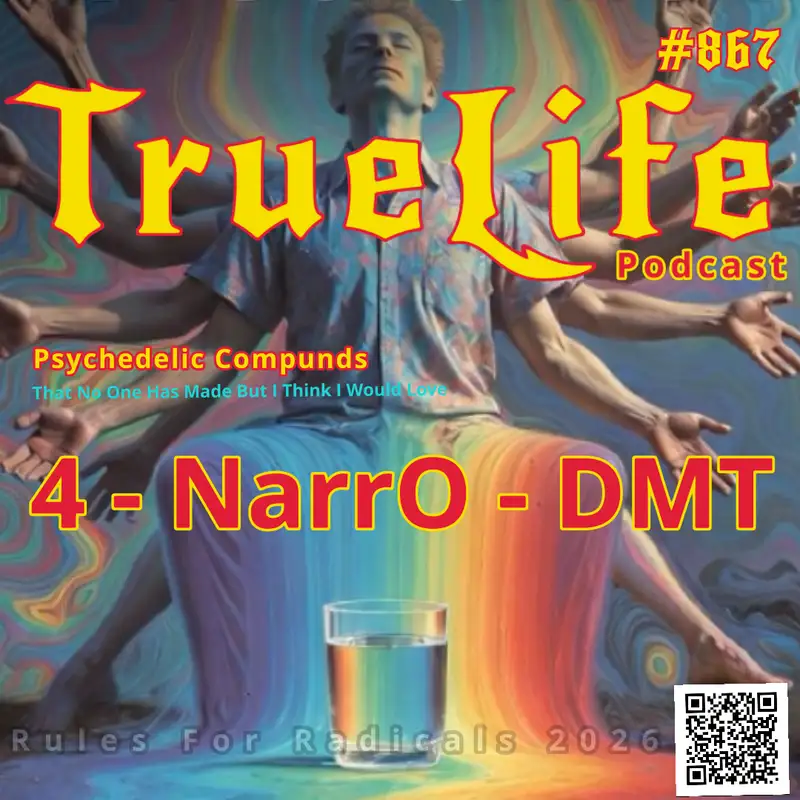
PSYCHEDELIC COMPOUNDS
That No One Has Made But I Think I Would Love
— Pilot Episode —
— ✦ —
4-NarrO-DMT
(4-Narratival-N,N-Dimethyltryptamine)
"The compound that makes you the narrator of your own story — and then fires the narrator."
— ✦ —
SECTION I: THEORETICAL SYNTHESIS
COMPOUND CLASS
Extended tryptamine scaffold. Specifically, a 4-position substituted derivative of N,N-DMT with a novel narratival moiety — a synthetic functional group designated -NarrO-, which has no parallel in the existing pharmacological literature and, frankly, in the existing literature of anything.
HYPOTHETICAL PRECURSOR ROUTE
The synthesis begins where most interesting things begin: in the dark. Specifically, in the dark corner of a theoretical lab where someone has left 4-hydroxy-tryptamine next to a compound that doesn't technically exist yet, which we'll call narrativaldehdye — a small, arrogant molecule that behaves like an aldehyde but insists it has something to say about the situation.
In a speculative Pictet-Spengler-adjacent condensation (one that would take place under conditions of approximately 37 degrees Celsius, ambient self-doubt, and the passive presence of someone who keeps almost calling you), the narrativaldehdye moiety is proposed to undergo electrophilic addition at the C4 position — the exact position, if you know your indole ring geometry, that governs the compound's relationship with reality's membrane.
The C4 position is where psilocin lives. Where the 4-HO group of every genuinely world-dissolving tryptamine lives. It is, structurally, the position most responsible for making you forget which side of your skull you're on.
We are putting a narrative structure there.
We are attaching the mechanism of story — subject, verb, consequence — directly onto the part of the molecule that interfaces with your visual cortex, your sense of temporal continuity, and your belief that you are a single, unified person who exists in one place at a time.
PROPOSED RECEPTOR PHARMACOLOGY
4-NarrO-DMT is theorized to act as a full agonist at 5-HT2A receptors (standard psychedelic mechanism — nothing unusual here, move along). However, the -NarrO- moiety is hypothesized to simultaneously and paradoxically bind sigma-1 receptors — those enigmatic chaperone proteins lodged in the endoplasmic reticulum membrane, which are implicated in memory consolidation, dissociation, and the general management of what the brain considers "a coherent timeline of events."
The proposed result of this dual binding profile: the 5-HT2A activation floods you with signal — overwhelming, luminous, Technicolor present-tense experience. The sigma-1 component simultaneously begins editing the narration of that experience in real time, inserting ellipses, switching perspectives, and occasionally substituting the third person for the first.
In plain language: you will have the experience, and the experience will be having the experience of you having it, and someone — possibly you — will be taking notes.
PROPOSED DURATION
6-9 hours. The narratival arc demands a three-act structure. The molecule insists on it. There is reportedly no way to leave at intermission.
STATUS
Theoretical. Speculative. Deeply, deeply imaginary. The narrativaldehdye moiety does not exist. The -NarrO- functional group has never been synthesized. This compound cannot be made, should not be made, and exists only in the space between two synapses that have already decided what they think is going to happen next.
That space, as we are about to discover, is enormous.
— ✦ —
SECTION II: TRIP REPORT
SUBJECT: Myself, probably. SETTING: Somewhere with good chairs. DOSE: Theoretical. INTENTION: To see what happens when the story turns around and looks at you.
T + 0:00 — ADMINISTRATION
I take it. Or I will take it. The tense is already softening at the edges. I take it in the form it presented itself — a small capsule the color of an overcast Tuesday — and I sit in the good chair, the one that has always seemed slightly too aware of my posture, and I wait.
[NOTE: Subject's initial posture described as 'respectful but not reverent.' This is considered optimal.]
T + 0:20 — FIRST ALERTS
He notices, first, that the room is still the room. This is important. He is experienced enough to appreciate the gift of a room that is still being a room. The plant in the corner is doing plant things. The window is committed to its window agenda. Everything is performing its function with quiet, professional dignity.
Then the sentences start arriving slightly before he thinks them.
Wait.
Something is — the plant is fine, the window is fine, I'm fine — but there is a quality to the air that I can only describe as editorial. Like whatever is about to happen has already been outlined. Like I am walking into a room where the furniture has been arranged specifically for me, by someone who knows me better than I'd prefer.
[NOTE: The narratival moiety is beginning to establish its binding. Subject is experiencing what researchers would call, if researchers existed who studied this, 'pre-narrative charge.' The sense that events have weight before they occur.]
T + 0:45 — ONSET
The ceiling does something that is not quite breathing and not quite grammar but is located exactly between the two. He watches it the way a person watches something that is watching them back without admitting it.
The ceiling is reading me.
Not in a threatening way. In the way a sentence reads its own words before committing to them. In the way 'the ceiling is reading me' reads itself just now and seemed briefly surprised to exist.
I am in the book. I have been in the book. The book is not about me — I want to be clear about this — the book is not about me. I am simply a perspective the book is using right now, the way a flashlight uses a beam. The flashlight does not claim ownership of the illuminated wall.
I am the flashlight.
...
Actually, I might be the wall.
T + 1:15 — THE COMEDY BEGINS
He stands up. He regrets standing up immediately. Standing up has committed him to a plot point he wasn't ready for. He is now a character who has stood up, and this has implications for the next scene. He cannot go back to being a character who was sitting without the narrative acknowledging the standing up.
I have made a structural error.
I stood up without narrative justification and now the compound is asking me, politely but very firmly, what I intended by that. What is the arc of the standing up? Where is this going? Standing up implies agency. Agency implies intention. Intention implies I have a plan, a direction, a reason for the suddenly vertical nature of my existence in this specific room on this specific evening.
I stood up because I wanted a glass of water.
The room waits.
I wanted a glass of water and it turns out that 'a glass of water' is a kind of objective — a goal, a small narrative engine — and the 4-NarrO-DMT finds this incredibly interesting. It has opinions. It wants to know what the water means. Is the water a reward? A transition? A moment of human self-care meant to signal the protagonist's tentative re-engagement with embodied existence? Or is the water — and here I notice the compound tilting its metaphorical head — is the water a MacGuffin?
Is the water a MacGuffin.
I am standing in my kitchen, jaw slightly open, completely unable to remember if I actually want water or if I have simply invented the desire for water as a narrative excuse to move to a new location and I
[TRANSCRIPT INTERRUPTION: 4 minutes of audio consisting entirely of the subject laughing in a way that several neighbors would later describe as 'technically concerning but rhythmically excellent.']
T + 2:00 — PEAK ONSET. THE NARRATOR SPEAKS.
And then it happens.
He is standing at the kitchen window when the perspective switches without warning. Not gradually. Not gently. With the clean, definitive snap of a camera cut.
He is watching himself stand at the kitchen window.
Not out of body — nothing so crude. He is still in his body. His body is right there. He can feel his feet. The feet are loyal and present and completely uninterested in the metaphysics. But there is a second register now, a second altitude, from which he is also watching. The way an author watches a character. The way a sentence knows it's a sentence.
He hears the narration.
It is his voice. It is not his voice. It is what his voice sounds like when it is describing him in the past tense that hasn't happened yet. And it says:
"He is standing at the window where he will have stood, later, when he tries to explain this. The window is doing the thing windows do at night — holding the outside and the inside simultaneously in its glass, refusing to choose. He looks like a man who has just realized that looking like something is a full-time job he never applied for."
I am hearing my own trip report as it is being written about me in real time.
I am the subject and the reporter. I am the event and the coverage of the event. I am the window, I think. I'm pretty sure I'm the window.
[NOTE: The sigma-1 / 5-HT2A dual activation is reaching proposed maximum binding saturation. The subject is experiencing what the theoretical literature — if it existed — might term 'narrative recursion': the self-as-observer observing the self observing, each layer generating another layer, the whole structure rising like a tower made of mirrors, reflecting mirrors, reflecting mirrors, turtles all the way down except the turtles are you and they are all writing about each other.]
T + 3:00 — THE TERRIFYING PART (ACT TWO)
The comedy stops with no announcement.
He is sitting again — when did he sit down? the narrative has elided the sitting, it considered the sitting unimportant — and the quality of the experience has changed in the specific way that weather changes before lightning: everything becomes very still and very aware of itself.
The narration has been friendly until now. Wry. A little sardonic. The kind of narrator you'd cast as a friend of the protagonist, someone who likes him but doesn't romanticize him. But the narration is shifting register.
It has something to say.
The narrator has something to say about me.
Not to me. About me. As if I am not here. As if the quality of my presence in my own story is a matter of some question.
And the narrator says — the other voice, the one wearing my voice like a coat it borrowed without asking — the narrator says:
"He has been waiting for permission. Not for this — not for the compound, not for the experience — for everything. For the life. He has been standing at the threshold of his own existence with one hand raised to knock, and the door has been open the entire time, has been open so long the hinges have rusted in the open position, and the knock has never landed because he keeps deciding the moment isn't right yet."
I don't want to hear this.
I did not consent to this part. I consented to the comedy part, I signed off on the epistemological confusion, I was prepared — enthusiastically — for the ceiling to read me. I was not prepared for the other voice to know things.
The narrator knows things.
The narrator is me, which means I know things, which means I have known things, which means at some level — some sigma-1, deep-endoplasmic-reticulum, memory-chaperone level — I have been storing knowledge about myself the way a library stores books no one has checked out in thirty years. Dusty. Catalogued. Inarguably present.
He is crying a little. Not dramatically. In the way you cry when something is simply and irreversibly true.
The plant in the corner pretends not to notice. This is very kind of the plant.
T + 4:30 — THE ABSURDIST RE-ENTRY
The narrator has said its piece and now it is quiet and I am sitting here in the wreckage of my own narrative self-knowledge and the first thing I notice, coming back, is that my left foot has fallen asleep.
My left foot is asleep.
I have just undergone a full Jungian shadow confrontation mediated by a fictional neuropharmacological entity and my foot — the one that was loyal, the one I thought was on my side — has opted out of consciousness entirely. My foot looked at the situation and said: not my problem. Napping.
He shakes his foot. The pins and needles arrive with the energy of a standing ovation.
He laughs again. This laugh is different from the MacGuffin water laugh. That laugh was the laugh of something being revealed as absurd. This laugh is the laugh of something being revealed as fine. As specifically, precisely, cosmically fine.
The narrator is still there. It will always be there — that's the proposed mechanism, the long-tail sigma-1 persistence — but it has stopped having opinions about my life choices and returned to its natural state: observing, annotating, occasionally catching my eye across the room with an expression that says: yes, I know. I know. The foot thing was funny. We're fine.
[NOTE: Subject is entering the proposed resolution phase. The dual binding profile has completed its intended circuit. The 5-HT2A signal is beginning to normalize. The sigma-1 narrative overlay is settling from active commentary into passive background presence — less narrator, more witness.]
T + 6:00 — RESOLUTION. THE THIRD THING.
I want to describe what the come-down of 4-NarrO-DMT would feel like.
Not the return to baseline. Not the gradual relinquishing of the visual distortions or the dissolution of the perspective switching. The specific texture of what's left.
What's left is this: a sense that the story is still going. Not in a frightening way. Not in the way that made the Act Two moment so airless and correct. In the way that a book is still going even when you've set it down. The characters are still in there, still moving through their scenes, and you — you, the reader — are still connected to them, still aware of their existence in some ambient, companionable way.
I am still connected to myself.
This sounds simple. It is not simple. Most of the time — most of the ordinary, un-theoretically-synthesized time — there is a subtle disconnection between me-as-experiencer and me-as-narrator. The one who does things and the one who comments on the things are usually in separate rooms. One is always slightly behind the other, slightly delayed, like a bad satellite feed where the audio arrives after the mouth has moved.
4-NarrO-DMT synced them.
Not permanently. Not in a way I can hold onto after the compound has fully cleared. But long enough to feel what it is like to be both: to do the thing and tell the story of the thing in the same breath. To act and witness simultaneously. To be, in the most complete sense I have available to me, a present-tense person.
He sits in the good chair. The chair is still slightly too aware of his posture. He considers this acceptable.
The plant in the corner nods. Or doesn't. It's a plant.
The narrator takes a breath — his breath, through his lungs, via the standard cardiopulmonary infrastructure — and adds one final note to the record:
"He came back from it. They always come back from it. That is not the interesting part. The interesting part is that coming back was not the same as returning. He came back different, but the difference is not a thing you could measure or name. It is the difference between a window that has been cleaned and a window that hasn't. Same window. Same light. But something about the way you see through it now."
— ✦ —
SECTION III: SYNTHESIST'S FIELD NOTES
ON THE COMPOUND
4-NarrO-DMT is imaginary. I want to be clear about this. The narrativaldehdye moiety doesn't exist. The sigma-1/5-HT2A dual binding profile is speculative to the point of being basically a creative writing exercise in receptor pharmacology. I have not made this compound. I have not taken this compound. I will not take this compound because it does not exist.
But the experience it theoretically produces — that one is real. The sense of being narrated. The doubling of observer and observed. The moment when the inner voice stops being ambient noise and becomes something that has opinions, and information, and is pointing at things you've been pretending not to see.
That experience is available. It does not require 4-NarrO-DMT. It requires only that you sit in the good chair, in the company of whatever you've been carrying, long enough to let the narration begin.
The compound just makes it unavoidable.
The compound makes it funny first.
I think that's important. I think if you're going to learn something true about yourself it's better if a molecule makes you laugh about a glass of water first. It's better if the cosmos reveals itself via a foot that fell asleep. It's better if the terrifying thing comes in through the side door, during a comedy, when your defenses are down because you're still giggling about the MacGuffin.
That's why I'd love this compound.
Not because of the insight. Because of the order of operations.
Funny first. True second. Both simultaneously, then.
ON THE FORMAT
This is the first entry in an ongoing series of compounds that no one has made. Each compound will have a structure, a proposed mechanism, and a speculative experience. Each experience will be reported by a narrator who is also the subject, who is also losing track of which one they are.
You're invited to lose track with them.
END OF EPISODE ONE
4-NarrO-DMT (4-Narratival-N,N-Dimethyltryptamine)
Status: Theoretical. Beautiful. Pending.