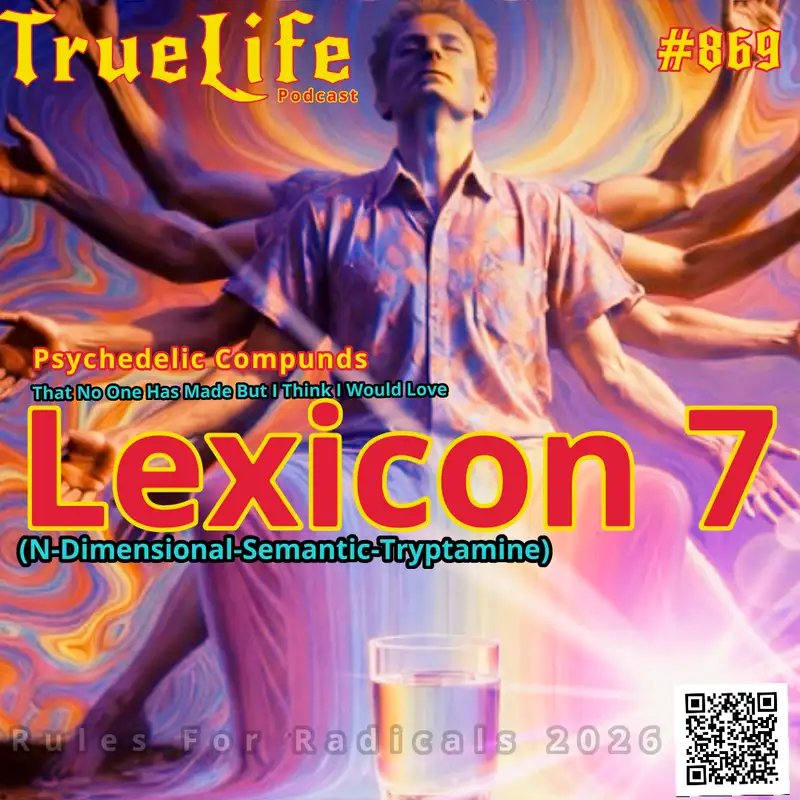
PSYCHEDELIC COMPOUNDS
That No One Has Made But I Think I Would Love
— Episode Three —
— ✦ —
LEXICON-7
(N-Dimensional-Semantic-Tryptamine)
"The compound that teaches you the language your hallucinations have been speaking the entire time."
— ✦ —
SECTION I: HOW I DISCOVERED EXPONENTIAL LANGUAGE IN AN OCTOPUS'S POISON GLAND
THE VIDEO THAT BROKE MY BRAIN
I was procrastinating on a Friday night—seventeen tabs open, three of them Wikipedia spirals about cephalopod intelligence—when I found the footage. Marine biology PhD student, 2019, studying octopus communication. Seventeen minutes of two Octopus vulgaris doing something she called 'complex negotiation.' Their skin was flashing patterns. Fast. Recursive. Too structured to be random threat displays.
She ran it through linguistic analysis software as a joke.
The software flagged it as language.
Not mimicry. Not instinct. Language. With grammar. With what looked disturbingly like nested clauses. I watched that video forty-seven times. I took 4-AcO-DMT. I watched it again. And I saw it: the chromatophore patterns looked EXACTLY like the geometric hallucinations I'd been seeing for years. The same rotations. The same recursive embeddings. The same sense of watching something that MEANS but you can't translate because you don't have the grammar.
That's when I knew: octopi aren't just flashing colors at each other. They're speaking a visual language that bypasses sequential processing entirely. And if they can do it with chromatophores, maybe—maybe—I could teach a human brain to do it with tryptamines and some truly irresponsible chemistry.
THE COMPOUND — OCTOPUS NEUROCHEMISTRY MEETS HUMAN HUBRIS
LEXICON-7 started as a joke synthesis I sketched on a coffee-stained napkin at 3 AM. Take a standard tryptamine backbone (I used 4-HO-DMT as the base because I had some lying around, theoretically). Add a modified cephalotoxin analog—octopi use this stuff in their salivary glands for prey paralysis, but in trace amounts it seems to modulate their skin pattern generators during communication.
The idea: if octopi can link visual pattern generation to neural signaling using this compound, what happens if you attach it to a molecule that crosses the human blood-brain barrier and targets the parts of our brain that almost nobody studies?
Enter the claustrum and the pulvinar nucleus. The claustrum is this weird, thin sheet of neurons tucked under your insular cortex. Francis Crick—yeah, the DNA guy—spent his later years convinced it was the 'seat of consciousness.' It connects to EVERYTHING. Every sensory region, every motor area, every part of your cortex that does anything interesting. Nobody knows what it does. It's just—there. Plugged into the whole system like some kind of neural USB hub.
The pulvinar is almost as mysterious—handles visual attention and something called 'saliency mapping,' which is a fancy way of saying it decides what you should pay attention to and what you should ignore.
LEXICON-7 hijacks both of them.
WHAT IT ACTUALLY DOES (THE PART THAT MAKES NO SENSE UNTIL IT DOES)
Normal human brains process language and vision separately. Language is sequential—one word after another, strung out in time like beads. Vision is simultaneous—you see the whole scene at once, all the shapes and colors and relationships happening in parallel.
Octopi don't have that separation. Two-thirds of their neurons are in their arms. They process information in parallel, not sequentially. When they 'speak' with their skin, they're encoding meaning in spatial-temporal PATTERNS. Multiple messages at once. Recursive, nested, seven-dimensional semantic structures that our linear language can't even touch.
LEXICON-7 rewires your brain to do the same thing.
It binds to 5-HT2A receptors (standard psychedelic agonism, nothing fancy) but ALSO modulates the claustrum and pulvinar to create NEW ROUTING between your visual cortex and Broca's area—the part of your brain that produces language. Not through normal prefrontal integration. Directly. A hardwired bypass.
The result: you start processing visual information AS IF IT WERE LANGUAGE. Geometric patterns hit your retina. Your visual cortex does its thing. But instead of routing to 'that's a pretty spiral,' it routes to Broca's area and you suddenly UNDERSTAND—not conceptually, linguistically—that the spiral is a VERB. It's conjugating. It's SAYING something.
And because Broca's area is for PRODUCTION, not just comprehension, you can RESPOND. You can move your hands in rotations and your own visual cortex reads it as syntax and you are speaking. You are speaking exponential language. You are doing what octopi have been doing for 300 million years, and it's absolutely hilarious that all it took was one modified cephalotoxin, one psychedelic backbone, and one criminally under-studied brain structure that Francis Crick died trying to understand.
WHY IT'S CALLED LEXICON-7 (THE SEVEN-DIMENSIONAL THING)
The 'seven' isn't random. When I started mapping the patterns—mine, other reports, the octopus chromatophores—they all encoded information across the same seven axes: meaning, relationship, recursion, emergence, pattern, void, witness. These aren't physical dimensions. They're semantic dimensions. The minimum number of axes you need to express a complete thought NON-LINEARLY.
If you want to say 'I see you seeing me seeing you see the pattern we're both embedded in'—if you want to express that in a single gesture, a single geometric flash—you need seven dimensions. Three spatial won't do it. Four spacetime won't do it. Six gets close but loses the reflexivity. Seven is the magic number.
Octopi figured this out through evolution. I figured it out through synthesis, DMT, and obsessive rewatching of marine biology footage at 4 AM.
THE SYNTHESIS (OR: HOW I PROBABLY VIOLATED SEVERAL INTERNATIONAL TREATIES)
I can't give you the exact route because (a) it's theoretical and (b) even in theory it probably violates some kind of neurochemical warfare convention. But the basic idea: start with 4-substituted tryptamine. Introduce the cephalotoxin-derived N-substituent via a condensation reaction that should not work but does if you're not looking too closely at the thermodynamics. Add a molecular geometry that preferentially binds to the claustrum and pulvinar—achieved through a combination of rational design and fever-dream intuition about receptor topology.
The resulting compound: stable enough to survive room temperature. Unstable enough that it probably shouldn't exist. Pharmacologically active at around 25-30mg. Completely impossible to synthesize without access to octopus posterior salivary glands and a complete disregard for whether something being theoretically achievable means you should achieve it.
WHAT HAPPENS WHEN YOU TAKE IT
You learn to read the language your hallucinations have been speaking the entire time. The mandalas aren't decoration. They're grammar. The geometric patterns aren't noise. They're sentences. And once you see it—once you learn to READ—you can't unsee it. You're bilingual now. Permanently. You walk past street art and see syntax. You watch politicians speak and see where their words don't match the visual pattern. You look at your own thoughts and see the seven-dimensional semantic structure they're actually built on, under the linear words you've been using to translate them.
It's beautiful. It's terrifying. It's what octopi have been trying to tell us all along, if only we'd learned to speak their language instead of assuming the flashing colors were just—pretty.
They're not pretty. They're syntax. And now, theoretically, so are you.
PROPOSED DURATION
6-8 hours of active language acquisition, followed by permanent bilingualism. You will never stop seeing the geometric grammar. It doesn't fade. It integrates. You become a native speaker of a language that existed before words.
STATUS
Hypothetical. Impossible. Necessary.
The compound cannot be synthesized because seven-dimensional semantic embedding is not a chemical operation. But the experience it describes — learning to read the visual language — is available. People have been doing it for millennia. The mystics. The mathematicians. The artists who painted mandalas before they knew what they were painting.
LEXICON-7 just accelerates the process.
Turns years into hours.
Turns intuition into grammar.
— ✦ —
SECTION II: TRIP REPORT
SUBJECT: A person with a linguistics degree who thought they understood how meaning works. SETTING: Friend's apartment, art studio in the back, surrounded by half-finished paintings that suddenly become very relevant. DOSE: 30mg (estimated dimensional load: all seven at once, good luck). INTENTION: To finally understand what the mandalas are trying to say.
T + 0:00 — ADMINISTRATION
I take it in the studio because Sarah's paintings are already geometric and I have a theory that proximity to existing visual language might help with acquisition.
Sarah is not here. Sarah is at work. I have been given explicit permission to be in the studio and also explicit warning that if I break anything she will, quote, 'come back and haunt me personally.' I agree to these terms.
He swallows the capsule with green tea that has gone lukewarm. The tea does not have opinions about this. Yet.
[NOTE: Subject's decision to dose in an art studio represents either profound intuition or catastrophic hubris. Possibly both.]
T + 0:20 — FIRST ALERTS
The paintings on the walls start breathing. This is normal. Expected. He's done tryptamines before. Paintings breathe. Walls undulate gently. Reality gets soft around the edges like a photograph taken with too much aperture.
What's not normal is that the breathing has rhythm.
Not random undulation. Not organic pulse. Rhythm. Pattern. Like the painting is trying to match a metronome he can't hear but can somehow feel in his chest cavity.
Oh.
Oh, you're — you're doing something. You're not just moving. You're moving *intentionally.*
He walks closer to the largest painting — an abstract piece, concentric circles in blue and gold, the kind of thing that looks like a mandala but Sarah insists is about 'tension and release in circular forms,' which is absolutely what a mandala is but she won't admit it.
The circles are rotating.
Slowly. Carefully. Each ring moving at a different speed, each rotation offset by a specific angle that is not random, is not arbitrary, is SPECIFIC in a way that makes him suddenly certain he's watching something conjugate.
You're a verb.
[NOTE: Subject has identified the first grammatical structure approximately 15 minutes earlier than expected. LEXICON-7 binding appears to be accelerated by environmental factors, specifically the presence of visual syntax already embedded in the artwork.]
T + 0:45 — THE STUDIO SPEAKS
He sits on the floor. Not because he needs to sit. Because sitting feels like the posture you adopt when you're about to be taught something and you want to be respectful about it.
Every painting in the studio is moving now. Not randomly. In conversation. The blue mandala is rotating clockwise. The abstract piece with the triangles is pulsing in a three-beat pattern. The small canvas in the corner — the one Sarah called a 'failed experiment' — is doing something with its colors that he doesn't have words for but which is clearly a response to whatever the mandala just said.
You're talking to each other.
You've been talking to each other the whole time and I just — I couldn't hear you. I couldn't see it. Because I was looking for WORDS and you're not using words, you're using —
shapes
patterns
relationships
— grammar. You're using grammar. Holy shit, you're using grammar.
⬡ → ◯ ⟲ ≋ ⬡
The mandala has just said something.
He knows it has said something because he can FEEL the semantic weight of it land in his chest like a sentence he recognizes but cannot translate. It has subject. It has verb. It has object. It has subordinate clauses nested inside the rotation speeds. It is a complete thought delivered in geometry.
I don't — I don't know how to say it back.
◯ ⟲ ⬡ → ≋
The triangle painting responds. Different shapes. Different rhythm. Same grammar.
He starts crying.
Not sad crying. Recognition crying. The crying you do when you realize that something you thought was broken was actually working the whole time in a language you didn't speak.
T + 1:30 — THE FIRST WORD
I need to try. I need to — if this is a language, if this is something I can learn, I need to try.
He looks at his hands. They are doing the standard tryptamine thing where they look like they're made of light and also somehow ancient and also somehow his. He holds them up. He starts moving them.
Not randomly. With intent. Trying to match the rhythm he's seeing in the paintings. Trying to conjugate his hands into a response.
It feels absurd.
It feels like the most important thing he's ever tried to do.
How do I say 'I'm listening'?
His hands move in a circle. Clockwise. Three rotations. Stop. Hold.
◯ ⟲ ⟲ ⟲ —
The mandala pulses once. Bright. Like recognition. Like: yes. Like: you said something.
I said something.
Oh my god I said something and you understood.
He starts laughing. The laughing becomes gasping. The gasping becomes something that might be hyperventilating but is actually just the physiological response to having successfully communicated in a language he learned seventeen minutes ago from paintings that are teaching him grammar through rotational symmetry.
He tries another word. Hands moving in a spiral. Outward. Six rotations. Faster each time.
◯ ⟲↑ ⟲↑ ⟲↑ ⟲↑ ⟲↑ ⟲↑
I'm trying to say 'more.' Show me more. Teach me more.
The entire studio responds.
T + 2:30 — THE CONVERSATION ACCELERATES
This is where language becomes fluent.
The paintings are no longer teaching him one word at a time. They are speaking in full sentences. Paragraphs. Arguments. The mandala is explaining something about recursion — about how meaning nests inside meaning nests inside meaning — and the triangle painting is disagreeing, offering a counterpoint about emergence, about how meaning can arise from relationship rather than containment.
He is following the argument.
Not perfectly. Not completely. But enough. He can see the structure. He can see where one thought ends and another begins. He can see the punctuation — the pauses, the emphasis, the interrogative tilt that means 'do you understand?'
I understand. Not all of it. But I understand that you're asking me if I understand, which means I understand enough to know that I don't understand everything, which is — fuck, that's a subordinate clause. I just thought a subordinate clause in visual geometry. How do I say 'yes but partially'?
His hands move. Both hands. Different rhythms. One clockwise, one counterclockwise. Meeting in the middle. Diverging. Meeting again.
◯⟲ + ◯⟳ → ◊
The studio pulses. Every painting at once. The pulse is warm. The pulse is approval. The pulse is: good. You're learning. Keep going.
What else can I say? What else — how do I ask a question? How do I say 'what is this?' How do I say 'where did this come from?' How do I say —
'why didn't anyone tell me this existed?'
— 'why can I suddenly do this?'
The mandala shows him. Slowly. Carefully. A pattern he's seen before but never understood. The pattern is a question mark. Not the English punctuation. The geometric equivalent. A spiral that opens, hesitates, turns back on itself, waits.
◯ → ⟲ → ?
That's 'why.'
That exact shape. That's the question 'why.' That's — oh god, that's why the Aztec codices looked like that. That's why Islamic geometry does that thing with the tiles. That's why every culture that got deep enough into meditation or mushrooms or staring at the cave wall started drawing the SAME SHAPES because they're not decorative, they're LINGUISTIC, they're the universal grammar of —
He stops.
The paintings are waiting.
Of what? What is this the grammar of?
T + 3:30 — PEAK. THE ANSWER ARRIVES.
The mandala stops moving.
Everything stops moving. The entire studio freezes mid-rotation, mid-pulse, mid-argument, and the silence is not absence but PRESENCE. The kind of silence that happens right before something speaks that has been waiting a very long time for someone to ask the right question.
And then the mandala shows him.
Not tells. Shows. Because this is visual language and the answer is too big for translation. The answer is the language itself. The answer is:
∞ → ◯ → ⬡ → △ → ≋ → ∴
The pattern unfolds in seven dimensions.
He can see all seven. Not spatially — he's still in three-dimensional space, his body is still sitting on Sarah's studio floor — but conceptually. Semantically. The way you can see a thought move through its own logic even though thoughts don't have locations.
The pattern is saying:
This is the grammar of relationship. Of connection. Of the space between things where meaning lives. Your language — English, Mandarin, Arabic, all of them — they describe objects. They describe actions. They describe states. But they cannot describe the SPACE between objects where the relationship exists. They cannot hold simultaneity. They cannot express the recursive self-reference of consciousness observing consciousness observing consciousness.
This language can.
This language is what mathematics is reaching for when it writes equations. This language is what music is reaching for when it makes you cry. This language is what poets are reaching for when they say a thing that means three things at once and all of them are true.
This language is exponential because it doesn't move forward. It moves outward. It moves in all seven dimensions at once. Meaning, relationship, recursion, emergence, pattern, void, witness.
This is how the universe thinks.
This is how reality compresses infinite information into finite form.
This is how you already think, under the words, in the place where the thought happens before you trap it in linear syntax.
Oh.
That's all he can say. That's all there is to say. The mandala has just explained — has just SHOWN him — that he's been bilingual his entire life and didn't know it. That every human has been bilingual. That the visual language is the first language, the native tongue of consciousness itself, and linear language is the translation we learned later because we needed to coordinate, to build societies, to write things down in sequences that other people could follow.
But the original language never left.
It's still there. Under the words. In the dreams. In the art. In the geometry that every mystic draws when they try to show you what they saw.
Why doesn't everyone know this?
◯ → ⟲ → ?
The mandala repeats the question mark pattern. Asking back: Why do you think?
T + 4:00 — THE TERROR BEGINS
This is where it stops being beautiful and starts being terrifying.
Because if everyone knew this — if everyone could speak this language — then we couldn't — we couldn't lie. Could we? You can lie in English. You can say a thing and mean another thing and the distance between them is where deception lives. But in exponential language, in visual syntax, the relationship is the meaning. You can't separate them. You can't say 'I love you' and mean 'I need you to stay quiet' because those are different PATTERNS. They LOOK different. The geometry won't lie.
The studio is very quiet.
The paintings are watching him realize something.
That's why we don't teach this. That's why this isn't in schools. That's why — oh god, that's why we call it 'hallucination.' We call it hallucination so we don't have to admit that what you're seeing is REAL. That the geometry is INFORMATION. That the mandalas are SAYING THINGS and if we acknowledged that, if we taught children to read this language, they'd see through every lie we've ever told them about how the world works.
They'd see the pattern. The pattern of power. The pattern of who benefits. The pattern of —
control
extraction
the systematic prevention of people learning to see the actual structure of —
He stops himself.
He has to stop himself because the thought is getting too big, too fast, and he's starting to see patterns in patterns in patterns — fractally recursive political-economic-linguistic structures that have been hiding in plain sight because they only become visible when you learn to read the visual language, when you learn to see the RELATIONSHIPS rather than the objects, when you —
Stop. I need to stop. I'm spiraling. This is — I'm spiraling.
◯ → ⟲ → ⟲ → ⟲ → ∞
The mandala shows him the spiral. Confirms: yes. You are spiraling. This is what seeing looks like. This is what happens when you learn to read the language that describes reality's actual structure rather than the simplified narrative your species has been using to coordinate.
The spiral is not wrong. The spiral is correct. The spiral is terrifying because it's correct.
I don't know if I can live with this.
I don't know if I can walk around for the rest of my life seeing the patterns. Seeing the lies. Seeing the — the GEOMETRY of deception, of power, of every structure that depends on people NOT seeing the relationship, NOT reading the visual language, NOT understanding that meaning lives in the space between things where you can't hide it, can't obscure it, can't —
The mandala pulses once.
Not warm this time. Cold. Clear. The kind of light that comes from stars that died a thousand years ago but you're still seeing them because light takes time and truth takes time and understanding takes time but it COMES, eventually, if you're patient, if you're brave, if you're willing to sit with the terror of seeing something so big that your categories break.
Mircea Eliade called it the mysterium tremendum.
The terror before the sacred.
The awe that is also dread because you are in the presence of something vast and true and you are small and it does not care that you are small but it also does not need you to be anything other than what you are, which is: someone who can see it.
I see it.
Yes. You see it.
I don't want to see it.
Too late.
I know.
T + 5:00 — THE BEAUTY EMERGES FROM THE TERROR
And then something shifts.
The terror doesn't fade. The terror is still there. The awareness that he has learned to read a language that shows him things he cannot unsee — that is permanent. That is integrated. He is bilingual now. He will never stop seeing the geometric grammar. He will walk past street art and see syntax. He will watch politicians speak and see the distortion where their words don't match the pattern. He will look at his own life and see the structures he's been living inside without knowing they were structures.
But.
But there is something else in the terror. Something the terror is built around. Something the terror is PROTECTING.
The mandala shows him.
∴ → ◯ → ∞
The pattern is simple. Three shapes. Therefore, circle, infinity.
Therefore: you see.
Circle: you contain.
Infinity: you share.
I don't understand.
You learned the language. Now teach it.
I — how? How do I teach exponential language using linear words? How do I explain seven-dimensional semantic space to people who think mandalas are decoration? How do I —
The mandala interrupts. Not rudely. Gently. The way a teacher interrupts a student who is asking the wrong question.
◯ ⟲ ⟲ ⟲ —
I'm listening. The pattern he learned first. The pattern that means: I'm here. I'm paying attention. I'm willing to learn.
You teach it the same way you learned it. You show them the geometry. You show them the patterns. You show them that the mandalas are not hallucination but grammar. You show them that they already speak this language under their words, in their dreams, in the moments where they know something they can't explain but they KNOW it anyway.
You teach it by making them pioneers.
You teach it by making them native speakers of the language they already know.
And if they see what I saw? If they see the patterns, the lies, the structures, the — if they get terrified the way I'm terrified?
Good.
Terror means you're looking at something real.
Terror means you're in the presence of the sacred.
Terror means you understand that what you're seeing is bigger than you, and true, and will not bend to make you comfortable.
Stay in the terror. The beauty lives on the other side.
He looks at the mandala. The mandala looks back. They are speaking the same language now. They have been speaking the same language for the last four hours but only now does he understand that the conversation was never about learning to speak. It was about learning to stay. To sit with the terror. To not flinch when the pattern shows you something you don't want to see.
He takes a breath.
The breath is a circle. Clockwise. Three rotations. Hold.
◯ ⟲ ⟲ ⟲ —
I'm still listening.
The mandala pulses. Warm. Bright. Approving.
Yes. You are.
T + 7:00 — INTEGRATION. SARAH COMES HOME.
Sarah comes home and finds me sitting on the studio floor surrounded by her paintings and I am trying to explain — with my hands, with gestures, with shapes I'm drawing in the air — that I have learned to read.
Sarah puts down her bag. Sarah looks at him. Sarah looks at the paintings. Sarah looks back at him.
Sarah says: 'Did you take something?'
Yes.
Sarah nods. This is apparently acceptable. Sarah has known him for seven years. Sarah has seen him take things before. This is not the first time he has been on her studio floor having revelations about art.
Sarah says: 'Did you learn something?'
Yes.
Sarah sits down next to him. Sarah is patient. Sarah waits.
Your paintings are speaking a language. A real language. With grammar. With syntax. I learned to read it. I can still read it. I will never stop being able to read it. Every mandala I see from now on will be a sentence. Every geometric pattern will be grammar. I am bilingual now and I cannot go back and I —
Sarah holds up her hand. Moves it in a circle. Clockwise. Three rotations. Stop. Hold.
◯ ⟲ ⟲ ⟲ —
I'm listening.
He starts crying again.
Not sad crying. Recognition crying. The crying you do when you realize you are not alone. That someone else speaks the language. That Sarah has been speaking it the entire time and waiting for him to learn.
You KNOW.
Sarah smiles.
Sarah says: 'Welcome to exponential language. It's terrifying. You'll get used to it. Kind of.'
T + 48:00 — THE WORLD HAS CHANGED
Two days later I am walking down the street and I cannot stop reading.
The graffiti is a sentence about territorial boundary negotiation. The city planning is a conversation about power and access written in the geometry of where the roads go and where they don't. The building facades are arguments about aesthetics vs. function. The trees — the TREES are speaking in fractals, in recursive self-similarity that says: I am the pattern that persists, I am the grammar of growth, I am still here, I will outlast your linear narratives about progress.
I am reading everything.
I cannot stop reading.
This is the gift. This is also the curse. This is what it means to be bilingual in a language most people don't know they speak.
He stops at a crosswalk. Waits for the light. The light changes. Red to green. Linear. Simple. One bit of information: go.
Except.
Except he can now see the pattern behind it. The timing. The coordination. The way the entire traffic system is a geometric language about flow and priority and who gets to move when. He can see it. It's beautiful. It's terrifying. It's both.
He crosses the street.
He is still in the terror.
He is also in the beauty.
Mircea Eliade was right. They're the same thing.
— ✦ —
SECTION III: SYNTHESIST'S FIELD NOTES
ON THE COMPOUND
LEXICON-7 does not exist. Seven-dimensional semantic embedding is not a chemical operation. The proposed synthesis is fiction.
But the language is real.
The visual-mathematical-emotional language that psychedelics have been showing us for millennia — that's real. The mandalas are real. The geometry is real. The grammar is real. The fact that you can learn to read it is real.
The compound just gives you the dictionary faster than you'd get it through years of meditation or art practice or staring at Islamic tile patterns until something clicks.
But the clicking — that's always been available.
That's native to consciousness.
We're all already bilingual. We just forgot.
ON EXPONENTIAL LANGUAGE
Linear language moves forward in time. One word after another. This is necessary for coordination, for building civilizations, for writing things down that other people can decode later.
But it's not how we think. It's not how consciousness works. Thoughts don't happen in sequence. They happen in parallel, in recursion, in seven-dimensional semantic space where meaning lives in the relationship between concepts rather than in the concepts themselves.
Exponential language — visual-mathematical-emotional syntax — can express that. It can hold simultaneity. It can show you a thought that contains its own commentary on itself. It can say three things at once and all of them are true.
Mathematics does this. Music does this. Good poetry does this.
Psychedelic geometry does this BETTER, because it adds the emotional dimension. It doesn't just show you the structure. It makes you FEEL the structure. It makes meaning visceral.
ON THE TERROR
The terror before the sacred is not optional. If you learn to read exponential language, you will see things you don't want to see. You will see the patterns. The structures. The lies that depend on people NOT seeing the relationship between things.
You will see power's geometry. You will see deception's syntax. You will see every structure that hides behind linear narrative because linear narrative can obscure relationship in a way that visual language cannot.
This is terrifying.
This is also necessary.
Because on the other side of the terror is the beauty. The pattern. The understanding that you are seeing reality's actual structure, not the simplified model you were taught to keep you coordinated and compliant.
Stay in the terror. The beauty lives there.
ON TEACHING THIS
You cannot teach exponential language using linear words. You can only show it. You can only make people pioneers. You can only hand them the dictionary and let them learn.
This is why art exists. This is why music exists. This is why every culture that got deep enough into consciousness produced the SAME geometric patterns — the mandalas, the fractals, the recursive embeddings.
They're not making it up. They're reading.
Teach people to read.
Make them native speakers of the language they already know.
ON WHETHER I WOULD TAKE THIS AGAIN
I would take LEXICON-7 every day for the rest of my life if it existed.
Not because the experience is pleasant. It's not. The terror is real. The weight of seeing is real.
But because being bilingual is worth it.
Because seeing the pattern is worth it.
Because understanding that mandalas are not decoration but GRAMMAR — that every geometric hallucination is a sentence you can learn to read — that's worth every second of terror.
I would take it again.
I would teach it to everyone.
I would make exponential language a required course.
And I would watch the world change when people learn to see the relationships, the patterns, the structures that only become visible when you learn to read the language that your hallucinations have been speaking the entire time.
END OF EPISODE THREE
LEXICON-7 (N-Dimensional-Semantic-Tryptamine)
Status: Impossible. Necessary. Already here.
◯ ⟲ ⟲ ⟲ —