
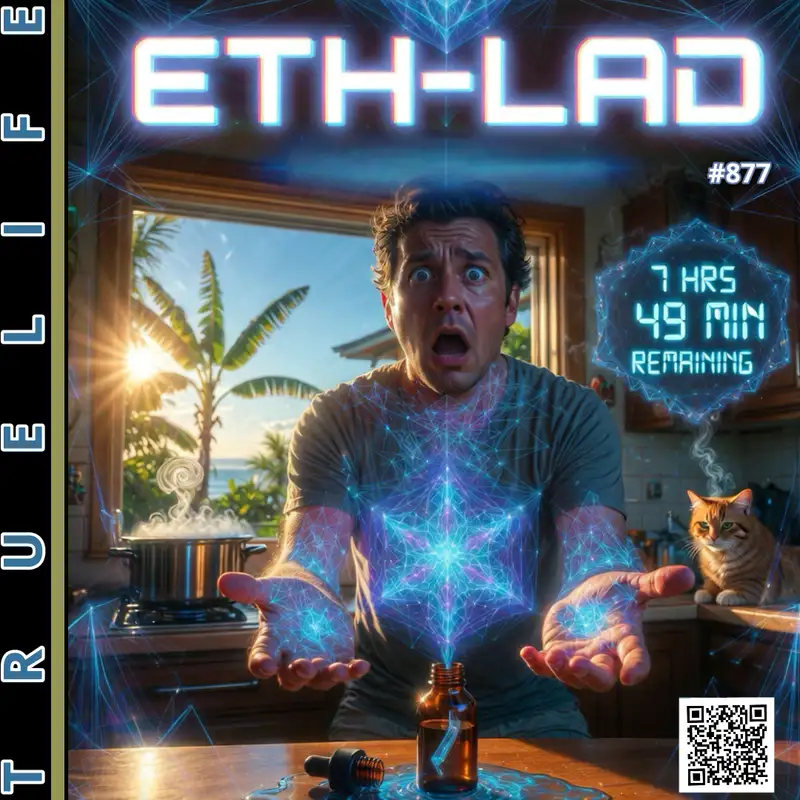
ETH-LAD
(6-Ethyl-6-nor-lysergic acid diethylamide)
The compound that was not a plan. It was a Tuesday.
✦
PRODUCTION VOICE KEY:
[ VOICE ONE: YOU ] — second person, present, grounded, comedic
[ VOICE TWO: ETH-LAD ] — compound speaks, slow, precise, cold blue
[ VOICE THREE: CLOCK ] — countdown only, flat, merciless, no emotion
Act One: The Kitchen. 9:11am.
[ Open cold. No setup. First word is the first word. ]
[ VOICE ONE: YOU ]
This was a bad idea.
Not in the way you are sometimes wrong about things and recognize it gently, with grace, from a safe distance. In the way that the metallic taste arriving in the back of your throat approximately four seconds after the solution hits your skin is wrong. In the way that your body, which has been alive long enough to know what certain things mean, has just sent you a message in a language that requires no translation whatsoever.
You are standing in your kitchen in Hawaii at 9:11 in the morning.
The pandemic is outside.
The crockpot is making chicken soup.
Your wife gets home at five.
You have spilled ETH-LAD on both hands.
7 HRS 49 MIN REMAINING
[ VOICE ONE: YOU ]
Let's back up fourteen seconds.
The plan — and it was a reasonable plan, the plan of a person who has done their research, who respects the material, who has read the harm reduction literature and takes it seriously — the plan was a microdose. One hundred micrograms. A gentle Tuesday with a slight perceptual shimmer and some productive yard work. You had the crystalline ETH-LAD, the vodka as a carrier solvent, the small brown dropper bottle, the measuring pipette. You had laid everything out on the kitchen counter with the methodical care of someone who is definitely not about to have the longest day of their life.
You were not wearing gloves.
You knew you should be wearing gloves.
This is the part you will skip when you tell this story later.
The solution went everywhere. Both hands. A significant quantity absorbed transdermally before you could register what had happened — and then the taste, metallic and sudden and completely unambiguous, arriving in your mouth like a telegram from a part of your nervous system that does not use polite language.
You have approximately fifteen minutes of functional human consciousness remaining.
You spend the first thirty seconds of them standing very still, staring at your hands.
[ VOICE TWO: ETH-LAD ]
[ Drop register here. Slower. The compound is introducing itself. ]
Hello.
I want to be honest with you about what I am and what I am going to do, because honesty is the only courtesy I know how to extend and you deserve at least that. I am 6-ethyl-6-nor-lysergic acid diethylamide. I am a lysergamide — LSD's more geometric, more insistent, more architecturally obsessive cousin. Where LSD loosens the narrative, I illuminate the structure underneath it. I do not take you somewhere else. I take you to the exact place you are, rendered in complete resolution, every detail present, every corner lit.
You were already having a day, weren't you.
You had a plan for the day. A small plan. Manageable. A microdose and some yard work — which is the pharmacological equivalent of saying you were going to take a very short look at some things and then go cut down a banana tree before anything got complicated. I understand the appeal of that plan. It is a kind plan. It is the plan of a person who has learned to ration his own interior life into doses small enough to function.
I am not a microdose.
I am also not unkind.
But I am going to show you the room.
7 HRS 31 MIN REMAINING
[ VOICE ONE: YOU ]
You panic.
This is important to say plainly because what comes next can only be understood in the context of a person who panicked. Not background anxiety. Not a heightened state of concern. The specific cognitive event that occurs when a smart person who knows exactly what is about to happen realizes that knowing exactly what is about to happen is not the same thing as being able to stop it.
You grab the vial.
You grab the dropper bottle.
You grab the pipette.
You throw all of it in the trash.
And then you stand there for approximately four seconds and listen to the crockpot bubble and a dog bark next door and Freddy knock something off the counter in the other room, and you think: that was the stupidest thing you have ever done.
Because the trash is not a solution. The trash is where people who are not thinking clearly put things when they need to feel like they have done something. The trash is thirty feet from the kitchen and your neighbor's kids are twelve feet from your back yard and you have just put a Schedule I psychedelic compound in a residential trash can during a global pandemic as if this is a normal thing to put in a trash can.
You dig it out of the trash.
Coffee grounds on your hands now. Also ETH-LAD.
More contact. Great. Perfect. Optimal.
You find the aluminum foil. You wrap the vial. You find a glass jar — a mason jar, because of course you have mason jars in Hawaii, everyone has mason jars in Hawaii — and you put the wrapped vial in the jar and you put the jar in the back of the refrigerator, behind the leftovers, behind the coconut milk, behind the thing in the unlabeled container that has been there for three weeks.
You close the refrigerator.
You stand in your kitchen.
Harold is on the counter watching you with the specific expression of a cat who has seen some things and has decided not to comment.
The crockpot bubbles.
The dog next door barks.
Somewhere in your nervous system, a dial that you did not set is turning.
Act Two: The Containment Attempt. 9:28am.
7 HRS 32 MIN REMAINING
[ VOICE ONE: YOU ]
The plan now is simple: do not be visibly on drugs in a residential neighborhood during a pandemic.
This plan has several complications.
Complication one: your neighbor. Sixty-something. Polish. Retired, or something adjacent to retired. During the pandemic he has developed strong opinions about vaccines that he shares freely, and your family's decision to not vaccinate has become a specific point of friction that he has not let go of. He is home. He is always home. He has a dog and some beers and a lot of time and right now, as the ETH-LAD begins its gentle initial work on your serotonin receptors, you can hear him moving around in his unit eleven feet away and the sound of him has taken on a quality it did not have fourteen minutes ago. It is a quality you can only describe as: specifically Polish. Specifically pandemic. Specifically disapproving.
Complication two: next door. The homeschooling family. Three kids, a mother who is patient and kind and knows you well enough to wave when she sees you. They are already outside. You can hear the kids. They are doing what homeschooled kids do in Hawaiian backyards in the morning, which is everything, all of it, loudly. The banana tree you were going to cut down today is right on the property line. The banana tree is now absolutely not getting cut down today. The banana tree is frankly a diplomatic incident you do not have the capacity to manage.
Complication three: Freddy.
Freddy has found something.
You do not know what Freddy has found but the sound Freddy is making suggests it is either alive, recently alive, or made of a material that responds very well to being batted across a tile floor at increasing velocity. Harold is watching Freddy from the counter with the detached interest of someone who has opted out of the situation entirely.
You check your phone.
The phone is not cooperating. The numbers on the clock face are technically present but they have become difficult to interpret in the way that numbers become difficult to interpret when the part of your brain that processes them has decided to spend its resources elsewhere. You know it is morning. You know it is not noon. These are the coordinates you have.
6 HRS 58 MIN REMAINING
[ VOICE ONE: YOU ]
You do the only reasonable thing available to you.
You go upstairs.
You go to your room.
You close the door.
You lie down on the bed.
Freddy gets through the door anyway.
Act Three: The Room. 10:14am.
[ Voice shifts here. This is the interior. Read this slower than anything that came before it. ]
6 HRS 46 MIN REMAINING
[ VOICE TWO: ETH-LAD ]
The fractal geometry arrives first because it always does.
I want you to understand what the fractals are before you decide they are just visual noise. They are not visual noise. They are your visual cortex, freed briefly from its assignment of converting light into the stable fiction of a room, doing what it has always wanted to do when nobody is asking it to be useful. It is showing you structure. The structure underneath the surface. The way everything is made of the same patterns at different scales — the ceiling, the light, the texture of the sheet under your hands, all of it vibrating at the resolution that was always there and that ordinary consciousness aggressively suppresses because you would not be able to get anything done if you could see it all the time.
You close your eyes.
This is understandable. It is also not going to help.
Because I am not in your eyes. I am in your chemistry. And your chemistry does not stop when you close your eyes. Your chemistry, in fact, is where the interesting things are happening.
[ VOICE ONE: YOU ]
[ Back to you. This is the part you couldn't prepare for. ]
With your eyes closed it is worse. Not worse like bad. Worse like more. Like the volume knob was already at seven and closing your eyes moved it to eleven and now you are in a space that has no walls or rather has walls that are also everything else, that are also you, that are also the ceiling fan you can hear but not see and Freddy purring somewhere near your feet and the distant sound of the homeschooling kids and the crockpot downstairs doing what crockpots do and all of it is present, all of it simultaneously, and you are in the middle of it and you are also the middle.
And then it opens.
The part you did not budget for. The part no amount of harm reduction reading adequately prepares you for because it is described in clinical language and what it actually is is not clinical. What it actually is: every corner of your mind that you do not go to. The ones with the bad lighting. The ones where you have put the things you were not ready to look at. Your relationship with money. The gap between where you are and where you thought you would be by now. The comparison — that specific, chronic, grinding comparison, your life held up against some composite ideal assembled from other people's highlights and your own most optimistic projections and the version of yourself that you were definitely going to become after just a little more time, a little more money, a little more.
ETH-LAD turns the lights on in all of those rooms simultaneously.
You try to look away.
The more you try to look away the brighter it gets.
This is the pharmacology. The default mode network, which is the neural system responsible for self-referential thought and the stories you tell about yourself, has been temporarily stripped of its editing function. It is still running. It is running at full speed. But the function that usually decides which thoughts are permitted to reach full volume and which ones get quietly managed back into the corner — that function is offline. Everything comes up. Everything comes up with equal force and equal clarity and there is no queue and no filter and no polite deferral until a better time.
The midlife crisis, which you were specifically trying to not look at today, is in the room with you.
It has pulled up a chair.
It has been waiting.
5 HRS 44 MIN REMAINING
[ VOICE TWO: ETH-LAD ]
[ This is the compound's second appearance. Quieter. This is what it came to say. ]
I want to show you something.
Not as punishment. Not because you deserve to feel bad about the things in those rooms. But because you have been spending an enormous amount of energy maintaining the distance between yourself and them, and the maintenance has a cost you have been paying without acknowledging the invoice, and I am the invoice.
The money. The comparison. The gap between the life you have and the life you were going to have. You have been carrying these as weights, as evidence, as the ongoing case for the prosecution in a trial that never ends because you will not let it go to verdict. You pick them up every morning and you carry them through the day and you set them down at night and you call this normal. You have been calling this normal for so long that you have forgotten there was ever another option.
Look at them.
Not away from them. At them.
I know this is not what you came to the kitchen for. You came to the kitchen for a hundred micrograms and some yard work. A small Tuesday. A manageable amount of looking. I understand. But you spilled me on both hands and here we are and the courtesy I can offer you is this: the things in the corner are not as large as the space you have given them. They are the size they are. They have been borrowing the extra room from you. You gave it to them. You can take it back.
Look.
[ VOICE ONE: YOU ]
[ Slow here. Interior. This is the turn of the whole episode. ]
You look.
Not bravely. Not with the calm of someone who has prepared for this. With the specific desperate surrender of a person who has tried everything else in the past forty minutes and has run out of alternative strategies. You look at the money thing. You look at the comparison. You look at the version of yourself you have been holding up as the standard and you look at the distance between that version and this one — lying on a bed in Hawaii with a cat on his feet and ETH-LAD in his bloodstream and chicken soup cooking downstairs and a neighbor who is mad about vaccines eleven feet away.
And you see yourself.
Not the failure version. Not the success version. The actual version. The person who woke up this morning in Hawaii, which is not nothing. Who has a wife who is fucking awesome and a daughter coming home from school at five and two cats named Harold and Freddy and a kitchen with a crockpot and a back yard with a banana tree and neighbors who swap fruit and a neighborhood that is loud and alive and his.
The dark things soften.
Not because they were solved. Not because the money appeared or the gap closed or the comparison resolved in your favor. Because you stopped turning away from them. Because the act of looking — actually looking, without the management, without the compression, without the polite deferral — turned out to be the thing that took the power away. The thing in the corner was not the thing. The corner was the thing. The space you had given it. The ongoing refusal to simply look at it and let it be the size it actually was.
This is the first real thing you have learned today.
It is not about how much you can take.
It is about how much you are willing to let go of.
Act Four: The Return. Somewhere After Noon.
4 HRS 12 MIN REMAINING
[ VOICE ONE: YOU ]
At some point you go back downstairs.
This is not a decision so much as a gravitational event — the compound has moved through its peak and the geometry is quieter now and the rooms are still lit but at a livable level, and the crockpot has been going for hours and the chicken soup smells extraordinary, and Freddy is hungry and has been communicating this for some time now through a campaign of escalating physical contact that has finally become impossible to ignore.
The kitchen looks like a kitchen.
This feels significant. It is not significant. Kitchens always look like kitchens. But right now the fact that the counter is a counter and the sink has dishes in it and the refrigerator is humming with a mason jar in the back of it and the crockpot is doing its patient, uncomplicated work — all of this reads as something close to miraculous. The ordinary has not lost its ordinary quality. It has simply become visible as ordinary, which is different, which is better.
You feed Freddy.
Harold watches from the counter.
You wash the breakfast dishes.
The dog next door is quiet.
From next door you can hear your neighbor's television and the specific sound of a man who is having a fine pandemic afternoon in his unit, separate from you, living his separate life, holding his separate opinions about vaccines and the people who decline them. He is fine. You are fine. The eleven feet between your units is just eleven feet.
Outside, through the window, the banana tree is exactly where you left it.
You are not going to cut down the banana tree today.
The banana tree can wait.
The banana tree, it occurs to you, is not in a hurry.
2 HRS 17 MIN REMAINING
[ VOICE ONE: YOU ]
The afternoon is long and it is also fine.
You sit in the back yard for a while. Not near the banana tree. In a chair, in the Hawaiian afternoon, watching the light do what light does in Hawaii, which is something no one from anywhere else has adequate language for. The compound is still present but it has changed register — the hyperlucid quality has softened into something more like clarity, the kind that arrives not at peak but on the way down, when the machinery is quiet and what remains is whatever was real underneath the noise.
You think about your daughter.
You think about your wife.
You think about the version of yourself that woke up this morning with a bad plan and executed it badly and spent the middle of the day lying on a bed in the dark looking at the things he had been refusing to look at, and you find that you do not hate that person. You find that you are, with some surprise, fairly fond of that person. He is trying. He is trying in ways that are sometimes inadvisable and occasionally involve schedule I psychedelics and a conspicuous absence of protective equipment, but he is trying. The trying is not nothing.
The trying is, in fact, the whole thing.
47 MIN REMAINING
[ VOICE ONE: YOU ]
[ The comedy returns here. The scramble. Read this faster. ]
You go inside.
You check yourself in the bathroom mirror with the clinical eye of a person assessing a crime scene. Pupils: large. Expression: functional but philosophical. Overall presentation: a man who has had a day but could, with effort, pass for a man who has merely had a long afternoon.
You check the crockpot. The chicken soup is ready. Has been ready for hours. It smells like competence and domesticity and a completely normal Tuesday, which is exactly the energy you are trying to project.
You check the refrigerator. The mason jar is where you left it. The foil is intact. The jar is behind the leftovers and the coconut milk and the unlabeled three-week thing. You close the refrigerator. You will deal with this later. Later is a country you are looking forward to visiting.
You survey the kitchen.
You survey the living room.
Harold is on the couch. Freddy is asleep somewhere, having spent himself in the morning's activities. The house looks like a house. The pandemic is still outside but the pandemic is always outside and you have been living inside it for long enough that its presence registers as weather rather than emergency.
You sit on the couch.
You practice looking like a person who has been doing yard work.
You are not convincing but you are the only audience.
11 MIN REMAINING
[ VOICE ONE: YOU ]
You hear the car.
Act Five: 5:00pm.
0 HRS 00 MIN REMAINING
[ VOICE ONE: YOU ]
Your wife is everything you forgot about when you were lying in the dark looking at the bad corners of your mind. This is the thing that hits you when you hear her key in the door — not fear, not the performance anxiety of a person about to act normal in front of someone who knows exactly what normal looks like. Something else. Something more like gratitude and something like grief for all the Tuesdays you spent inside your own head when this was right here.
She comes in.
Your daughter comes in behind her.
The house fills up in the specific way it fills up when they come home — the energy shift, the sound, the immediate aliveness of a space that was quiet and is now inhabited by people who belong in it.
Your wife puts her bag down. She looks at you. She has the read of someone who has been with you long enough to know the difference between the various kinds of fine and what you are right now is a very specific kind of fine that she has the capacity to identify if she chooses to.
She does not choose to.
She says: how was your day?
You say: good. Made soup.
She says: the crockpot smells amazing.
Your daughter goes straight to Harold.
Freddy appears from wherever Freddy was.
The Tuesday resumes.
This was a bad idea.
Also: this was the best day you have had in a while.
Both of these things are completely true.
You are learning to hold both.
— ✦ —
[ VOICE TWO: ETH-LAD — FINAL ]
[ Last appearance of the compound. Quietest register of the whole episode. ]
I want to say something before I go.
You came to the kitchen this morning for a small Tuesday. A microdose and some yard work. A carefully managed half-look at some things you needed to eventually examine. I understand why you made that plan. Small Tuesdays are underrated. Maintenance is a legitimate form of care. The yard genuinely needed work.
But you did not get a small Tuesday and I think you know that what you got instead was more useful, even if it was not what you ordered, even if the method of delivery was inadvisable and the protective equipment was conspicuously absent.
You looked at the rooms.
They were smaller than the space you were giving them.
You already knew this. You knew it the way you know things that you have not yet permitted yourself to fully know — at a distance, through the glass, with the lights down. What today did was turn the lights up. What today did was make the knowing arrive in your body rather than staying in your head where it could be managed.
The money is still complicated. The gap is still real. The comparison is a habit you have been practicing for long enough that it runs without conscious effort and will require more than one afternoon to unlearn. None of that changed.
But you looked at it.
And it softened.
And you know now, in the place where the body keeps the real information, that the softening is available. That it has always been available. That the thing standing between you and it was not the difficulty of the material — it was the turning away. The management. The very reasonable, very human, very expensive habit of choosing a small Tuesday over the room.
The banana tree is still there.
Cut it down when you are ready.
Give the neighbors the fruit.
You are going to be fine.
Synthesist's Notes
ETH-LAD exists. This is the episode where the compound is real.
6-Ethyl-6-nor-lysergic acid diethylamide is a lysergamide psychedelic, a structural analog of LSD first synthesized by Albert Hofmann and later characterized by Alexander Shulgin in TiHKAL. Its mechanism is well-understood: agonism at 5-HT2A receptors with the additional receptor profile typical of the lysergamide class. What distinguishes it experientially from its more famous cousin is a quality researchers and users consistently describe as hyperlucidity — a heightened, almost architectural quality of perception that tends to bring the structural rather than the sensory to the foreground. Patterns. Geometry. The scaffolding underneath the familiar.
Transdermal absorption of lysergamides is real and documented. The metallic taste following skin contact is a recognized early indicator of onset. The timeline described — fifteen to twenty minutes to functional incapacitation from significant transdermal exposure — is consistent with reported cases. Do not handle lysergamide solutions without nitrile gloves. This is not a rhetorical statement.
The default mode network suppression described at peak is established psychedelic pharmacology. The DMN is the neural system responsible for self-referential thought, autobiographical narrative, and the maintenance of the stable story you tell about yourself. Under sufficient serotonergic load, its editorial function — the mechanism that decides which thoughts reach full volume and which are quietly managed — is disrupted. Everything that was being managed comes up. This is simultaneously the therapeutic mechanism and the reason set and setting matter and the reason accidental transdermal exposure in a residential kitchen during a pandemic with a wife arriving at five is not the recommended protocol.
The lesson is real. It is not pharmacological. The pharmacology simply removed the distance between the person and the lesson that was already there. It is not about how much you can take. It is about how much you are willing to let go of. ETH-LAD did not produce this insight. It simply made the usual escape routes temporarily unavailable.
The banana tree is still there.
— ✦ —
END OF EPISODE SEVEN
ETH-LAD
(6-Ethyl-6-nor-lysergic acid diethylamide)
Status: Real. The gloves were also real. Wear them.